

Table of Contents
- Start With a Measure-and-Declutter Workflow
- Small Kitchen Storage Ideas That Use Vertical Space
- Apartment Kitchen Cabinet Organization That Actually Fits
- Small Kitchen Counter Organization: Keep Only What Earns Its Spot
- How to Organize a Small Kitchen Without a Pantry
- Match Storage Solutions to Your Apartment Kitchen Layout
- How to Organize a Small Apartment Kitchen on a Budget
- Conclusion
- Frequently Asked Questions
Last Updated: October 17, 2026
Start With a Measure-and-Declutter Workflow
Most people buy organizers before they know what they're organizing. That's backward. Learning how to organize a small apartment kitchen starts with two boring steps: measure, then purge. The kitchens that stay tidy are the ones planned around real dimensions and real habits, not wishful thinking.
Here's the workflow that works:
- Empty one zone at a time (a drawer, a cabinet, a counter stretch).
- Sort into keep, donate, and toss.
- Measure the empty space: width, depth, and height.
- Write down what needs to live there.
- Buy only what fits your numbers.
It takes an afternoon. It saves you from a shelf of organizers that don't fit anything.
Measure Before You Buy Anything
Grab a tape measure and a notebook. Record the inside width, depth, and height of every cabinet and drawer. Note the gap between the counter and upper cabinets. Check door swing clearance too.
Why bother? Because a bin that's two centimetres too wide is useless. And return shipping is a chore nobody enjoys.
Clear the Counters First
Counters are the easiest space to reclaim. Pull everything off, wipe the surface, and put back only what you used this week.
A common mistake is keeping appliances out "because they're convenient." If a gadget hasn't run in a month, it belongs in a cabinet or a donation box.
The goal is simple: clear surface, clear mind.
Small Kitchen Storage Ideas That Use Vertical Space
The wall above your counter is the most underused real estate in a rental. Small kitchen storage ideas that go vertical free up counter space without adding furniture. Think wall shelving, a hanging rail, hooks, hanging baskets, and a magnetic strip for knives.
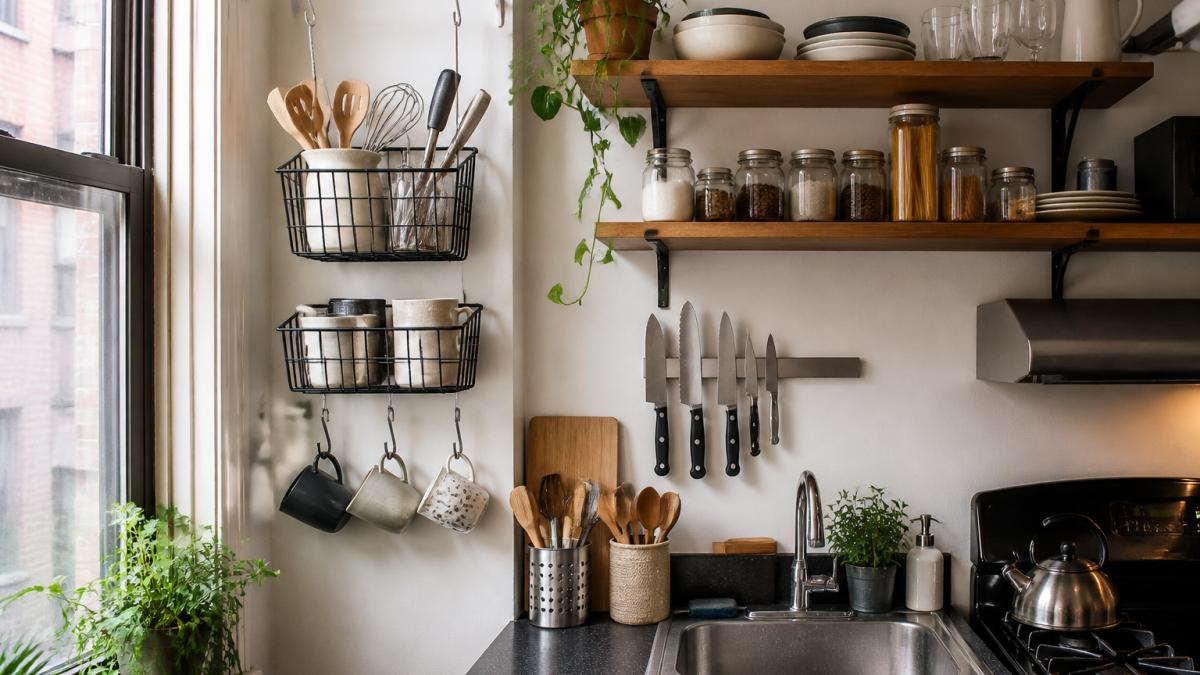
A few options that work well:
- Open wall shelves for jars, mugs, and daily dishes
- A hanging rail for utensils, towels, and small pans
- Hooks for aprons, measuring cups, and keys
Mount shelves above eye level for rarely used items. Keep everyday things within easy reach.
Renter-Safe Installation and Removal
No-drill storage is your best friend in a rental. Tension rods fit inside cabinets and across window frames. Adhesive hooks hold light items on tile and painted walls. Over-the-door racks hang on cabinet doors without a single screw.
For anything heavier, use removable adhesive strips rated for the weight. Test on a hidden spot first.
Apartment Kitchen Cabinet Organization That Actually Fits
Apartment kitchen cabinet organization comes down to one rule: match the organizer to the shelf, not the other way around. Upper cabinets hold daily dishes and dry goods. Lower cabinets hold pots, pans, and heavier items near the floor. But the rule only works if you know your cabinet's real dimensions, which is why the measure step from earlier matters here more than anywhere else.
What most guides miss is depth. Deep cabinets swallow small items, and shallow cabinets reject standard bins. Fix both problems with a shelf-by-shelf plan:
- Stackable organizers to double shelf height in tall upper cabinets
- Tiered organizers so cans and spices sit in rows instead of a pile
- Drawer dividers to keep a silverware drawer from turning into a junk pile
Use the Cabinet Door, Not Just the Shelf
The inside of a cabinet door is free storage that almost no renter uses. A shallow over-the-door rack or a set of adhesive hooks on the door panel holds measuring spoons, pot lids, cutting boards, and spice jars. Check that the door still closes fully before you load it, and keep the load light so the hinges don't sag.
Set Shelf Height Around What You Actually Store
Most apartment cabinets come with fixed shelves, but many have adjustable pegs. If yours do, lower the shelf above your plates so the stack sits close to the shelf above it, then raise the shelf above your tallest appliance. A few centimetres of adjustment often creates a whole new usable tier. If the shelves are fixed, use stackable risers to create the tier you can't build.
Keep Heavy Low and Daily Forward
Put the heaviest items, like cast iron, stockpots, and bulk dry goods, on the lowest shelves so you never lift them above shoulder height. Put the items you reach for every day at eye level and in the front half of the shelf. The back half of a deep cabinet is for backups and rarely used pieces, and it should be the first place you check before buying a duplicate.
A cabinet that fits its contents stays organized. A cabinet full of mismatched bins does not, no matter how good they look.
Small Kitchen Counter Organization: Keep Only What Earns Its Spot
Small kitchen counter organization is about earning space, not filling it. Every item on the counter should justify its place by daily use.
Try this test: flip a small box upside down on the counter. If an item doesn't fit in it, it needs a home elsewhere.
A practical counter setup:
- One tray for oils, salt, and utensils near the stove
- One tiered organizer for fruit or coffee gear
- One clear spot for prep work, always empty
Keep cords tucked and small appliances grouped. A tidy counter reads as a bigger kitchen.
How to Organize a Small Kitchen Without a Pantry
Learning how to organize a small kitchen without a pantry means borrowing space from everywhere else.
Start with a rolling cart. A slim cart tucks beside the fridge or in a corner and rolls out when you cook.
Next, use the back of a closet door or a hallway wall for a shallow shelf.
For food inventory, follow a first-in, first-out rule. Label containers with the date you opened them.
Match Storage Solutions to Your Apartment Kitchen Layout
Every layout has a different weak spot, and the same organizer that saves a galley kitchen can block a studio walkway. Match your storage to the shape of your kitchen, not to a generic shopping list. Here is how each common apartment layout actually plays out.
| Layout | Weak Spot | Best Fix |
|---|---|---|
| Galley | Narrow walkway, little wall space | Vertical rails and over-door racks |
| L-shaped | Dead corner cabinets | Tiered organizers and lazy susans |
| U-shaped | Crowded counters | Under-cabinet hooks and a rolling cart |
| Studio open-plan | Storage bleeds into living space | A sideboard or bar cabinet as a divider |
Galley Kitchen: Protect the Walkway
A galley kitchen lives or dies on its aisle width. Before you add anything, measure the clear space between the two counter runs. A rolling cart or a stool that narrows that aisle below a comfortable walking width turns cooking into an obstacle course. In a galley, go up rather than out: a rail above the counter, hooks on the end wall, and over-door racks on the cabinet doors.
L-Shaped Kitchen: Solve the Corner First
The corner cabinet is the L-shaped kitchen's black hole. A lazy susan or a set of pull-out corner drawers turns that dead space into usable storage. On the counter, use the inside of the L for prep and keep the two arms for appliances and a tray. A tiered organizer in the corner cabinet lets you see cans and jars without emptying the shelf.
U-Shaped Kitchen: Reclaim the Counters
A U-shaped kitchen has plenty of cabinet space but often too little counter. Move utensils, knives, and small tools off the counter and onto under-cabinet hooks, a magnetic strip, or a rail on the backsplash. A slim rolling cart that tucks into one arm of the U holds overflow without eating prep space. Keep one full arm of the U empty for actual cooking.
Studio Open-Plan: Make Storage Disappear
In a studio, the kitchen is always on view, so storage has to look intentional. Closed bins and matching baskets on open shelving read as design rather than clutter. A sideboard or bar cabinet placed at the edge of the kitchen zone doubles as a visual divider and holds overflow pantry items, glassware, or small appliances. Choose one material and one colour for bins and stick to it so the open shelves look planned.
Kitchenette: Borrow Space Outside the Kitchen
A kitchenette, the single-wall setup common in micro-apartments, has almost no cabinet depth. Treat the rest of the apartment as overflow: a shallow shelf on the back of a closet door, a bar cart in the living area, or a storage ottoman for bulk dry goods. Keep only daily items in the kitchenette itself and store backups elsewhere.
Whichever layout you have, the test is the same: can you walk through, open every door, and reach your daily items without moving anything else? If yes, the storage fits the room.
How to Organize a Small Apartment Kitchen on a Budget
You don't need to spend much to make a small apartment kitchen work. Affordable, renter-friendly pieces do most of the job.
Priorities worth the money:
- Tension rods and adhesive hooks for no-drill hanging
- Stackable bins and drawer dividers for cabinets
- A slim rolling cart for pantry overflow
Skip the fancy matched sets. Buy one zone at a time and test what works before adding more.
This is where a curated store helps. Vino Store stocks practical, well-designed organization pieces that fit together, so you're not piecing an aesthetic together from five different shops.
One honest note: quality organizers cost a little more than bargain-bin versions. But a bin that cracks in a month costs more in the long run.
Conclusion
A small apartment kitchen can feel cramped, but it doesn't have to stay that way. The fix isn't more stuff. It's measuring first, going vertical, and giving every item a real home.
At Vino Store, we curate smart organization solutions and kitchen gadgets designed to make small spaces work harder.
Shop Now and turn your cramped kitchen into a space that actually works.
Frequently Asked Questions
How do you organize a small apartment kitchen when you can't drill into the walls?
Renters can still add plenty of storage without a drill. Tension rods fit inside cabinets and under sinks to hold cleaning supplies, hanging baskets clip onto existing shelves, and freestanding pot racks or rolling carts add storage you can take with you when you move. Adhesive hooks and magnetic strips handle lighter items like utensils and spices. Measure your space first and check each product's weight limit before loading it up, then test adhesive strips on a hidden patch of wall before committing.
How can I maximize storage in a small kitchen without a pantry?
Treat a freestanding sideboard or bar cabinet as your pantry. Group food by category, decant dry goods into stackable bins so you can see what you have, and keep a running inventory list on the cabinet door. Use the back of the door for hanging baskets, and reserve upper shelves for backup items while keeping daily staples at eye level. A rolling cart tucked beside the fridge works well for produce and bulk items, and it moves out of the way when you need the floor space.
What should go on a small kitchen counter?
Keep only items you use daily: a kettle, a coffee maker, a knife block or magnetic strip, and one tray for oils and utensils. Everything else belongs in a cabinet or on a wall rack. A tiered organizer or a small tray corrals clutter into one zone instead of scattering it across the counter. If an appliance hasn't been used in a month, store it and bring it out only when needed. Clearing the counter makes a small apartment kitchen feel noticeably larger.
How do I organize a small apartment kitchen on a budget?
Start with the free step: declutter and measure before buying anything. Then prioritize a few high-impact items, such as drawer dividers, a tiered organizer, stackable bins, and one rolling cart. These do more for a small apartment kitchen than a long list of gadgets. Set a spending cap per zone and buy only what fits your measured dimensions. Vino Store's collection of smart organization solutions is a good place to compare practical, well-designed options before you commit.